In our latest blog post, Dr Ben Pullan, Head of Classics, reflects on the Latin and Classical Civilisation Sixth Form trip to Greece.
Early on Thursday March 26, twenty-one pupils of Latin and Classical Civilisation, accompanied by all four of the Bryanston Classics Department, Dr Pullan, Doc Fearnley, Mr Fowler-Watt and Mrs Jones, headed off on the latest iteration of the Bryanston Sixth Form trip to Greece. This five-night trip had been designed to align closely with the Classical Civilisation A Level course – the pupils would see many of the sanctuaries and theatres that they study – but would also be an opportunity for excellent additional classical and cultural enrichment.
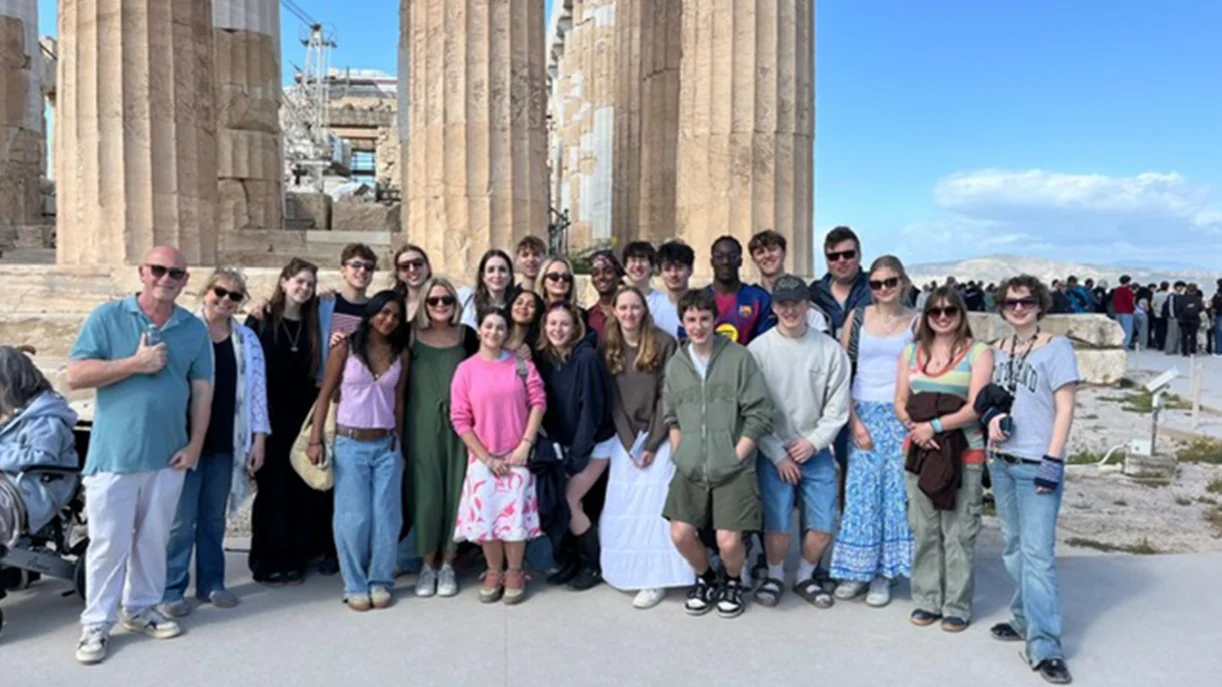
We arrived at Athens late on Thursday evening, and wasted no time in finding a local Greek taverna to tuck into our first of many delicious, authentically Greek meals. After this and a subsequent exploratory stroll around the centre of the city, we called it a night, all excited by what was set to be a highlight of the trip the following morning – a walk up the Acropolis to visit the famous sites there: the Theatre of Dionysus, Parthenon and the other temples.
The following morning dawned with brilliant sunshine, which provided a wonderful backdrop for our exploration of one of the most iconic sites of the ancient world. Our pupils study Greek Theatre as part of their A Level, and were therefore fascinated to see, nestled into the foot of the Acropolis, the Theatre of Dionysus – the birthplace of Western drama, and a place at which all of the ancient plays that they study would have been performed. This ancient theatre of the sixth century BC stands in stark contrast to the gleaming buildings of the later sanctuary above. As Doc Fearnley reminded us all, the Acropolis had once been sacked, razed to the ground by Xerxes’ Persians in 480 BC, before the Persians themselves had been decisively defeated by the Athenians both at sea – at Salamis – and on land – at Plataea – the following year. This conflict had provided the backdrop to the rise to power of Pericles and of the Athenian Empire, for whom the regeneration of the Acropolis had been their ultimate symbol of power. As one of our pupils reminded us, no temple on the Acropolis states this more obviously than that of Athena nikē (‘Victory’), placed as it is at the foot of the Propylaea, overlooking the island of Salamis, the location of the Athenians’ decisive naval victory over the Persians.
The octostyle 70×30 metre Parthenon, funded by Pericles and designed by Phidias to be the ultimate statement of Athenian power, made of gleaming Pentelic marble, never fails to amaze. Our pupils expertly talked us through the decorative sculpture – some of which is now controversially housed as the ‘Elgin Marbles’ at the British Museum – which would have further contributed to the temple’s wonder: pediments depicting both the birth of Athena (East) and contest between Athena and Poseidon for the patronage of Athens (West); metopes depicting the classic myths symbolising civilisation versus barbarism (Greeks versus Persians) – the Gigantomachy, Trojan War, Amazonomachy and Centauromachy; and of course Phidias’ masterpiece – the 12 metre chryselephantine statue of Athena that was housed within the temple’s naos. As a group, we would have an opportunity to take in these sculptures – some originals, some reconstructions – that afternoon in the Acropolis Museum, but not before we had checked out the Erectheion and its olive tree – the supposed site of the contest between Athena and Poseidon for Athens’ patronage, the Pnyx – the birthplace of democracy, and the ancient agora, not to mention enjoying a delicious mezze lunch in Plaka!
After a look round the wonderful Acropolis Museum, it was time to head off to our next destination, Delphi, located high on the slopes of Mount Parnassus. I always enjoy the late afternoon drive there from Athens, as one gradually ascends through stunning countryside and quaint, ski resort-like villages such as Arachova, before finally arriving at Delphi itself. After our late-evening arrival, we enjoyed another delicious meal at a chalet-style taverna, before settling down for some well-earned rest after a very long day.
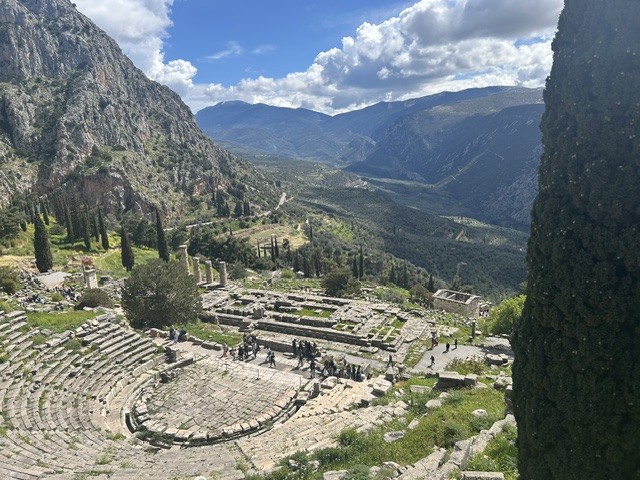
A morning walk around the site of Delphi is a true joy. As one gazes out from the slopes of Parnassus over the valley of Pleistos below, one can truly understand why it was perceived by the Greeks as the ‘navel of the universe’ and imbued with such mystical significance as the home of the Pythian priestess, the famous oracle of Apollo, upon whose prophecies great empires, such as that of Croesus of Lydia, collapsed. Our pupils were stunned by the beauty of the setting, and provided excellent discussion of the features of the site, including its wide range of treasuries (reflective of the lengths to which communities went to win the oracle’s favour), theatre of Dionysus (who supposedly replaced Apollo as the patron of the sanctuary for three months of the year), and of course the temple of Apollo (home of the Pythia) itself. Our pupils took this opportunity to deliver some wonderful reconstructions of consultation of the oracle – including some highly amusing prophecies indeed. After a quick look at the stadium situated at the top of the sanctuary, it was time for one of the best lunches of the trip: a descent down Parnassus to the coast of Itea, to eat calamari caught at 9AM that morning on the beach itself!
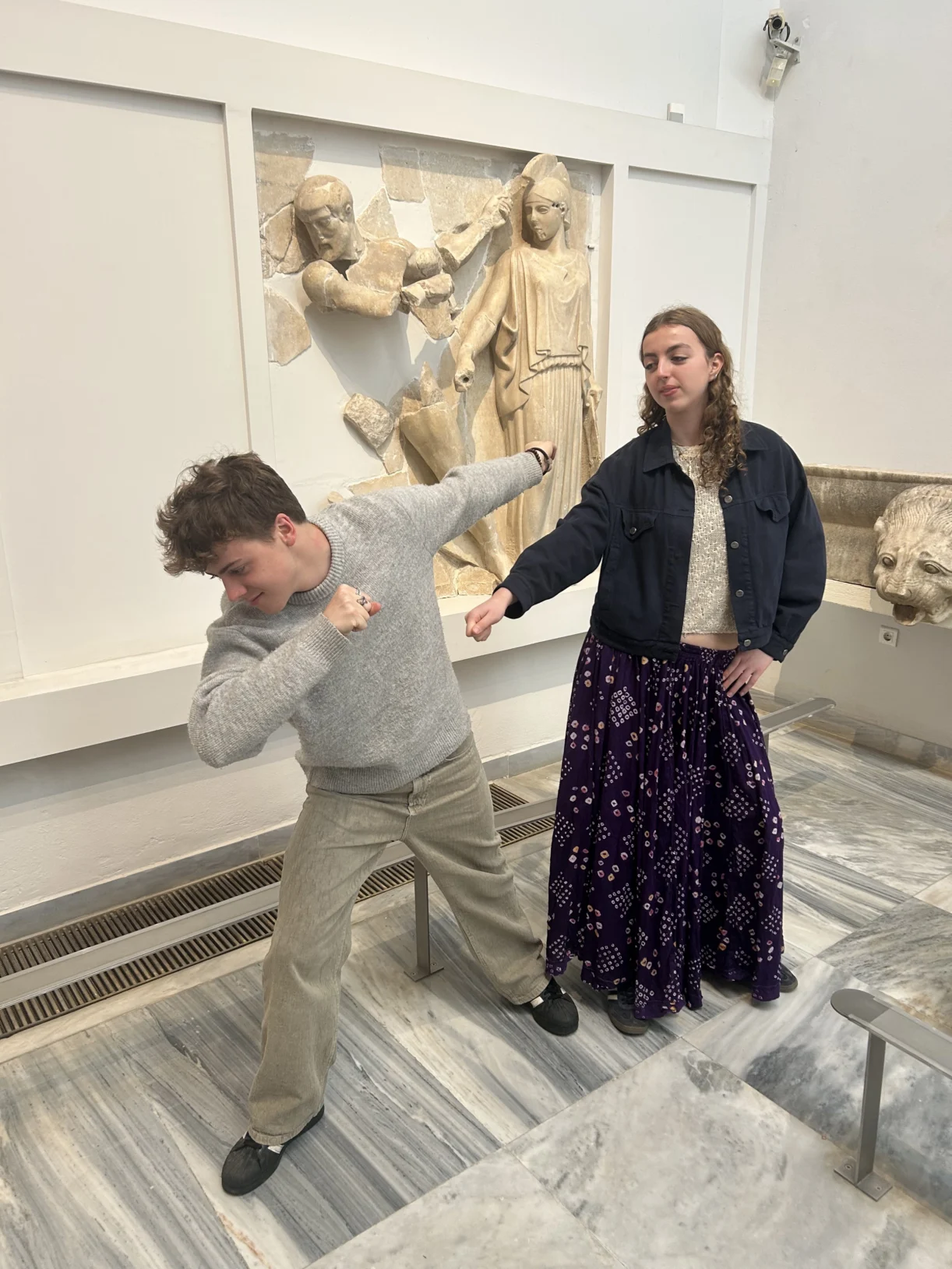
Feeling rejuvenated by both the historical and culinary delights that we had enjoyed that morning, it was time to head to our next stop of the tour, the Sanctuary of Olympia, birthplace of the Olympic Games in 776 BC. It is a long drive – first west and then south across the Gulf of Corinth and onto the Peloponnese – to get there from Delphi, but we made sure to break the journey up with a chance to try some delicious olive oil and other local delights. The following morning, we first headed to the excellent museum at Olympia, which contains the sculpture from the landmark Temple of Zeus that dominates the site. Our pupils gave excellent summaries of the myths depicted on each of the temple’s pediments – the chariot race of Pelops and Oenomaus on the East one and the Centauromachy on the West one – and the labours of Heracles that are depicted on its metopes, before Doc Fearnley gave her expert analysis of some of the other masterpieces of Greek art contained within the museum, namely the Hermes of Praxiteles and the winged Nike of Paionios. After taking in these sculptural marvels, it was time to explore the famous, Panhellenic sanctuary itself, which in springtime is full of a stunning array of wildflowers and blossoms. As we wandered the site, we imagined what it would have been like to train in the gymnasium, before re-constructing the East pediment of the Temple of Zeus that we had seen in the museum earlier, in front of the remains of the temple itself. A trip to the iconic stadium inspired some of the sportier members of the party to partake in a foot race, and then a game of one-bounce football. The sudden onset of a torrent of rain indicated that it was time for lunch – to be taken at one of our favourites, the Touris Club, with its famous self-service gyros station – before it was time to head to the Argolid, and our final stop of the tour, the beach resort of Tolo.
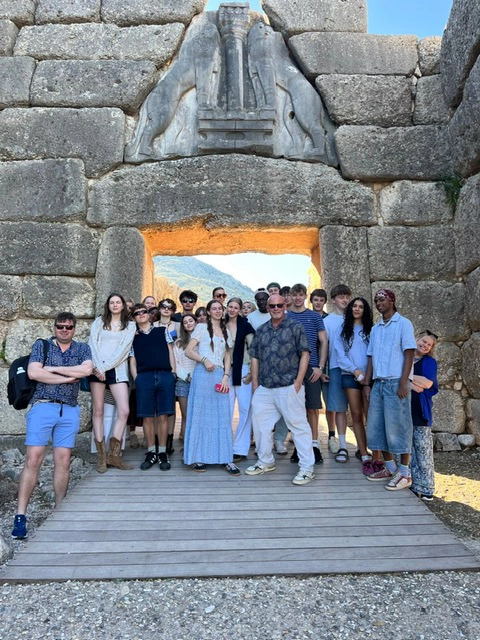
In the second millennium BC, the Argolid was the home to one of the most fascinating, but perhaps underappreciated, of ancient European civilisations, the Mycenaeans. It was this people, who dominated the Aegean for four hundred years but seemingly disappeared overnight in about 1200 BC, that inspired the epics of Homer and wider Greek mythology. As one drives across the plain of Argos, past the gigantic ‘Cyclopean’ walls of ancient citadels such as Tiryns, it is not hard to see why the Greeks of the Classical era regarded their long-lost predecessors with such awe. Having checked out the beach and town of Tolo that evening, the following morning we headed straight to the capital of this fabled civilisation, Mycenae itself, which Homer describes as ‘broad-wayed’ and ‘rich in gold’ and as the home of the house of Pelops and Agamemnon – the king who led the Greek host at Troy – himself. Even before one reaches the awesome citadel itself, they are struck by the gigantic beehive ‘Tomb of Atreus’, which provides an indication of the brilliance and scale of Mycenaean stonemasonry. This is confirmed when one encounters the massive walls – believed by the Classical Greeks to have been built by Cyclopes – and ‘Lion Gate’ of the citadel itself, the latter of which is one of the earliest examples of Western European sculpture on a monumental scale. As one walks up to the ‘Palace of Agamemnon’ at the top of this epic citadel, it is easy to envisage just why Homer and others were so awestruck by it. In the remains of the palace, we reenacted one of the most famous scenes of Greek myth, which supposedly occurred there, the brutal murder of Agamemnon at the hands of his vengeful wife Clytemnestra and her suitor Aegisthus, as he took a bath, having just returned from ten years of war at Troy. After taking in the famous cistern, carved deep into the hillside, and Heinrich Schliemann’s finest archaeological find – the ‘Mask of Agamemnon’, in the museum – it was time for lunch, which was enjoyed in the beautiful seaside town of Nafplion, with its excellent range of seafood mezze options.
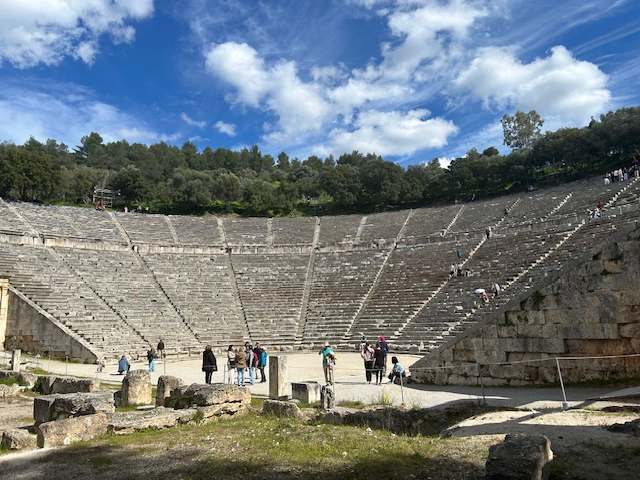
For our final afternoon, we headed to Epidauros, one of Mr Fowler-Watt’s favourite places in the world, on account of its theatre, which is both gigantic and brilliantly preserved. This theatre, which could have seated up to 15,000 spectators, is famed for its extraordinary acoustics – a coin dropped in the middle of the stage can be heard on the fifty-fifth and top row of seating! In the past, pupils and teachers have been able to perform for the group, and all week long, we had been hoping this would be the case once again. The presence of a rather officious-looking attendant, armed with a whistle, made us doubt whether we would be able to do this, but thankfully Mr F-W was allowed to give a memorable recitation (from memory) of the poem ‘Heraclitus’ by William Jonson Corey, which was met with rapturous applause and gushing praise from the hundreds of people exploring the theatre. The couple of lines he managed to sing of Elvis’ ‘Can’t help falling in love’ was greeted with an even greater response! After checking out the Sanctuary of Asclepius, and museum, that was our sightseeing done for the trip, and it was time to return to Tolo, for an afternoon at the beach, and final-night quiz and prize-giving, before our rather early departure the following morning.
As we spent the final night together, we all reflected on what a wonderful trip it had been. It had reconfirmed to me the absolute excellence of trips such as these, both pastorally and academically. In regards to the former, it had seen a group of pupils across two year-groups come together and hopefully create friendships that would last for the rest of their school days and beyond, and in regards to the latter, it had allowed them to walk in the footsteps of the ancients, hopefully providing real colour to the content that they have studied in class, and inspiring them to pursue their classical interests further.