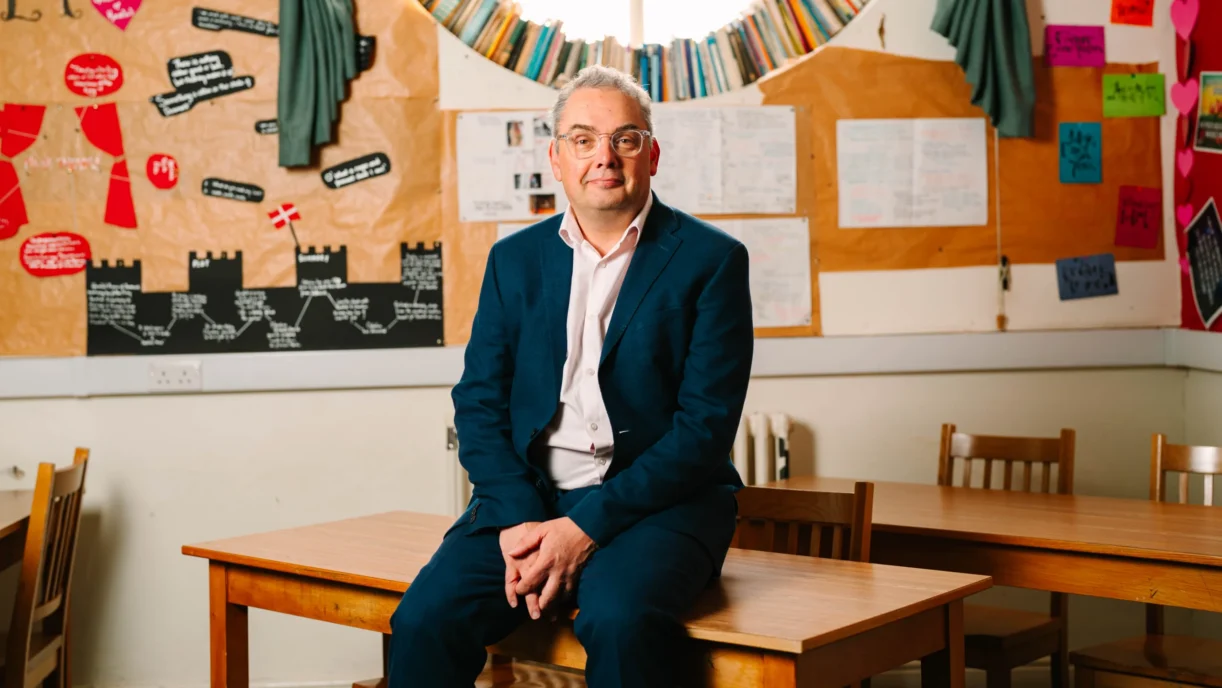
Bryanston’s new Head of Sixth Form, and English teacher, Stephen Davies, explores how independence, and the Bryanston Method help pupils grow into thoughtful, self-directed young adults.
As a teacher I enjoy all my classes. But the moment I look forward to most each year is welcoming pupils into the Sixth Form and onto my A Level English course. Every September brings a sense of freshness and renewal. There’s a smaller group in the classroom; the desks might be arranged differently, the atmosphere less formal. There’s far less of the tedious business of classroom management. You just get on with it.
But also, as a wise former colleague of mine used to say (and he was right), there’s no hiding place. Not for the pupils and not for the teacher. We’re in it together, eyeball to eyeball.
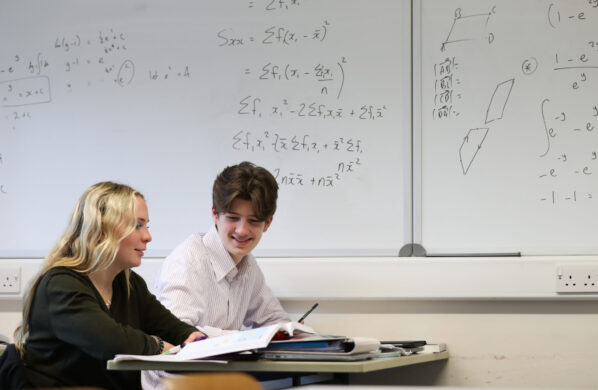
In a Sixth Form class, silence isn’t an option. You need a view. You need a voice. I will ask for it. The result, of course, is that classes become more interesting. The alternative is the teacher droning on, and nobody wants that. What I see over the first term is pupils gradually recognising who they are becoming. Freed from the grind of GCSEs, they have chosen three or four (or six, for IB) subjects that they genuinely care about. They are in the sunny uplands at the top of the school, following their own distinctive pathway.
Often, Sixth Form classes teach you as much as you teach them. Last term, while I was discussing a novel partly set in Manila, I asked, rather casually, whether anyone had ever been there. I had been blithely generalising, wildly and inaccurately about what sort of place it might have been. In fact, the only knowledge I had was from the set text itself. A pupil raised her hand and offered some really interesting observations about life in the city, having lived there herself.
Knowledge is shared and not just delivered.
One of my favourite assignments that I set for my Sixth Form classes explores identity. Who are you? What shapes you? From where do you get a sense of yourself? I tell them they don’t need to share their work with me. It can be purely personal. Yet almost all choose to. What they write consistently challenges the stereotype of teenagers. Their reflections are thoughtful, balanced, grateful, warm, and often humorous. They write about family, culture, love, history, change and challenge. Social media barely features.
Forgive the cliché, but it really is a privilege to witness this process of self-understanding.
And later, of course, I get to introduce them to ‘Hamlet’!
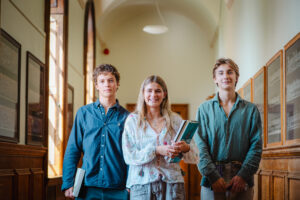 What I think is particularly exciting and different about the Sixth Form at Bryanston, is that yes, it is a new start, but in many ways, it is also a continuation. Because, to simplify things, we kind of teach pupils how to be Sixth Formers from the moment they arrive at the school. From D (Year 9) onwards we don’t tell them when to do their assignments. We sit them at their desk at certain times in the week and say it’s assignment time, but they decide which assignment to do and when. And then we also have these mysterious things called assignment periods (or study periods, or library periods) and in D they might have one or two a week; in C (Year 10) and B (Year 11) they might have three or four a week depending on their options; and by the Sixth Form of course you’re having seven or eight a week.
The big challenge is to do a very difficult thing – a thing that many of us adults are not so good at – to learn to work when nobody is watching.
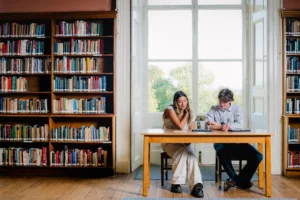
It is my personal view that great maturing happens in the Sixth Form. The Bryanston Method means they’ve been learning to be mature for several years already. It’s no surprise to any of our Sixth Formers to have an hour in the day when they must sit in a library room, find the right materials, look at what work is a priority, and get their heads down. Not everyone gets it right all the time, of course. But many do. And even when motivation begins with something practical, finishing work so there’s time later for sport, rehearsal or art, it often develops into something deeper. The ability to learn for yourself, and for the sake of learning.
Our Sixth Form philosophy is very distinctive.
We don’t have a shiny new Sixth Form Centre; we don’t separate our Sixth Form from other year groups by putting them in a different house. We simply want them to evolve out of the junior years to become part of the whole school, and to set an example across the whole school. In shared library spaces, younger pupils sit alongside older ones. Expectations, habits and culture pass gradually and imperceptibly from one generation to another. What we do have, too, is accountability. Our Sixth Form culture insists that pupils have one-on-one or small group sessions with their teachers on a weekly basis (we call them ‘Correction Periods’ or CPs). Again, in those sessions, there is no hiding place. Our eChart also gives staff, pupils and parents access to weekly information, targets and progress. If work is late, or sub-par, then it comes up in red.
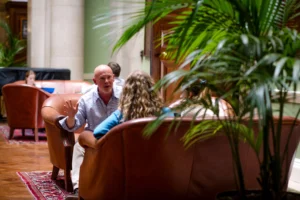
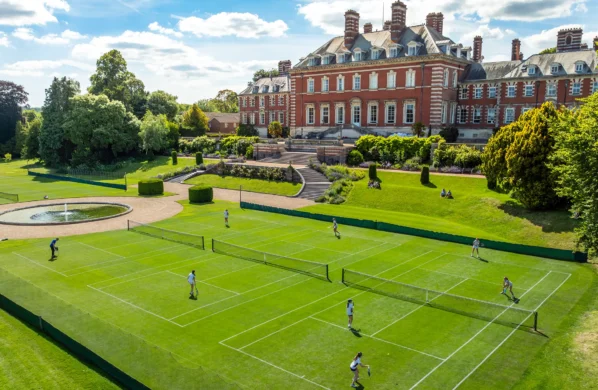
Even the physical layout of Bryanston reflects how our pupils study. The Library is not a single room but spread across all the historic state rooms and subject areas of the school. Independent scholarship happens everywhere, in the Science Department, the Art Department, the Classics Subject Room, The Art History Subject Room, and so on. It is part of the daily atmosphere.
We are not trying to produce a certain type of pupil.
Bryanston is a broad church and we welcome diversity. We focus above all, absolutely above all, on pastoral care and on the wellbeing of our pupils. We apply pressure where it is helpful and appropriate and remove it where it is not. That is the humane way to lead people out, to e-ducate them as (in the Latin origins of the word) and I believe that’s how you get the best out of Sixth Formers.
We ask them what they think. We let them wear what they like (to a degree – there is no uniform). We want them to be themselves. We are not a hot house, nor are we interested by league table positions.
 What matters is that pupils discover their own direction, whether that leads to an apprenticeship, whether it be on art foundation at the Ruskin in Oxford, or in London, or in Falmouth, whether it’s film production, whether it’s travelling, whether it’s going to an international university, setting up your own business – you get the idea.
Nearly a century of Old Bryanstonians are now out in the world. The Bryanston Method has been in place since the school’s foundation in 1928. We trust it. Our pupils trust it. And if some are too cool to admit it, it is working quietly beside them, for them, helping to build those magical moments and connections that are permanent and define their time here.