When Sebastian was eight years old, he decided he wanted to be an inventor. It is the sort of childhood dream most people quietly grow out of but not Conran. By the time he was at Bryanston he had reframed his ambition in becoming an engineer, then studied psychology “because if you want to design things, you need to know how people think.”
Design, in the end, was inescapable. His father, also an OB and one of the most influential figures in British design of the last century, gently redirected him towards a designer’s life. “My father persuaded me to be a designer,” Conran says. “My first job was stacking shelves in Habitat aged 15.” The teenage shelf-stacker would go on to become one of the country’s leading industrial designers, but he still talks about his work with the curiosity of that eight-year-old inventor, forever taking the world apart to see how it might be reassembled better.
Growing up Conran
Having a famous design impresario as a father was both a blessing and, at times, excruciating. “Everyone knew my dad,” he remembers.
Despite the pressure and visibility, he credits his father with an extraordinary eye for talent and a belief that design should be both useful and emotionally engaging. “All design must be useful. It must be emotionally engaging, and you have to build trust in others,” he says. “My dad was fabulous at spotting talent. We are there to inspire others.”
Persistence, pencils and the creative mindset
Ask Conran what advice he would give his younger self about creativity, and he doesn’t hesitate in answering “persistence.” “Think of an idea, then write it down, and then think of a better one. Keep going,” he says. “I also get quite impatient, which is also quite important as it drives you.”
For him, good design begins in the mind but is shaped by the hand. Despite his deep engagement with digital tools, he remains a champion of sketching. “You must have the idea in your head first and imagine it. Pencil and paper are a good way to start as it’s very intuitive, and you don’t get that same feeling with a keyboard and mouse.”
This belief in a designer’s mindset underpins his view of what young designers need today. It’s less about specific software skills and more about ways of seeing. “You need to think differently, have a designer’s mindset,” he insists. “You must problem-solve in unexpected ways and spot an unmet need. You must realise there are lots of solutions out there and to realise it is possible.”
From drawing boards to CAD and now AI
Conran’s career tracks the technological shifts in design tools. “When I was at Bryanston I did technical drawing O Level. You drew in pencil, then graduated to pen and then used a razor blade. I could then work as a draftsman in a design studio,” he recalls.
Decades later, lockdown forced him into another transformation. Working alone, he taught himself computer-aided design. “It was amazing,” he says simply. CAD replaced rulers and razor blades; now the design world faces another watershed moment in artificial intelligence.
Will AI change his design practice? “No one really has the answer to that,” Conran admits. For all its promise, he is clear-eyed about its limits. “At the moment, AI is not really neurodiverse and design thrives off atypical thinking. AI gives the obvious answer to a question, but the great thing about human beings is they’re not obvious.”
He defines creativity as a “sum of expertise, imagination, judgment and taste.” AI, he concedes, can tick some of those boxes. “But how good is it at imagining and discerning things? That’s what a successful designer is all about.”
Why atypical thinkers matter
One of the themes Conran returns to repeatedly is neurodiversity. His view is unequivocal. Atypical thinkers are essential to creative industries and to society.
“The Royal College of Art is one of the most creative colleges in the world and it has a high proportion of neurodiverse people working as interns,” he notes. The divergence, he suggests, is not in potential but in environment. “Often neurodiverse people don’t think they’re suited to school and give up in education.”
He reels off names including Einstein, Steve Jobs, his father, to make the point that minds which sit somewhere on the spectrum often drive the biggest leaps in innovation. “Now it’s defined as atypical thinking. Every team should have at least one atypical thinker in it. Most entrepreneurs have an element of atypical thinking which is part of their success.”
Bryanston, he says, played a vital role in his own development. “Bryanston in particular allows atypical thinkers like me to flourish.”
From idea to object
Ask Conran to describe the journey from a spark of inspiration to a product on the shelf and his answer is briskly methodical. “You do your research; understand an unmet need; understand how things are made; work out what you want to achieve,” he explains.
Crucially, this is never a lone-genius process. “It’s a team effort and collaborative. It’s about feeding each other, not feeding off each other. Contributory not competitive.” He sketches the typical stages – research, set objectives, create, develop, test, commercialise, sell.
Running through all of this is a guiding question. How will it benefit the end user? “How will I leave the world a better place?” he asks. “If you don’t have a customer experience, you won’t have a user experience. What will make my product stand out? How will it enrich a life?”
Communication, he admits, has been one of his biggest personal challenges as a designer. “Understanding people and getting ideas across,” he says. “I have a clear idea of what I want to achieve, but you must allow other designers to input their creativity. How can I guide and mentor young designers when I think I know what is right?”
The answer, for him, lies in trust and inspiration rather than control.
Education in the age of AI
Education, Conran believes, is on the cusp of transformation and AI will inevitably be part of it. But, echoing his comments on design, he stresses that technology must adapt to people, not the other way round.
“AI is going to be a part of education but it is going to have to understand everyone’s differences,” he says. “Education needs to be tailored to core strengths and should be adapted to pupils in a way that is best for you.”
This personalised, strength-based approach is especially vital for neurodiverse students, for whom one-size-fits-all schooling can be alienating or even destructive.
Hard work, happiness and “robofacturing”
For all his talk of imagination and atypical thinking, Conran is equally clear about the unglamorous side of success – work. A young designer, he says, needs “enthusiasm and self-belief. You have to prove yourself and learn on the job. Work harder than any other person.”
He is also passionate about making, not just designing on a screen, but understanding materials, craft and fabrication. Traditional craft, he warns, “is an endangered activity. We need to know how to make things, how to thatch roofs etc. Form follows fabrication.”
But he doesn’t romanticise the past. For Britain, he argues, the future lies less in traditional manufacturing and more in what he calls “robofacturing”. “Robots can deal with the dangerous, dreary jobs and leave us time to learn to make and be spiritually enriched,” he suggests.
As for intellectual property, he offers a typically sideways answer. “You can’t lead without people following.” Leadership in design, in other words, is ultimately proved not in patents but in influence.
Giving back to Bryanston
Despite his global career, Conran’s affection for Bryanston is undimmed. He speaks warmly of the school’s ethos and its willingness to nurture unconventional thinkers.
“Finally, I firmly believe in Bryanston’s ethos and giving something back and sharing experience,” he says. “My father and I got a huge amount from being a part of the Bryanston community. We both really loved it there. We would not have had such spiritually enriched lives if we had gone anywhere else. I genuinely believe it.”
From the boy dreaming of inventions to the designer championing atypical minds, Sebastian Conran has spent a lifetime asking how things could be better – products, systems, schools, even the way we work with machines. His answer is to understand people, think differently, work hard, and always start with the question of how to enrich someone’s life.
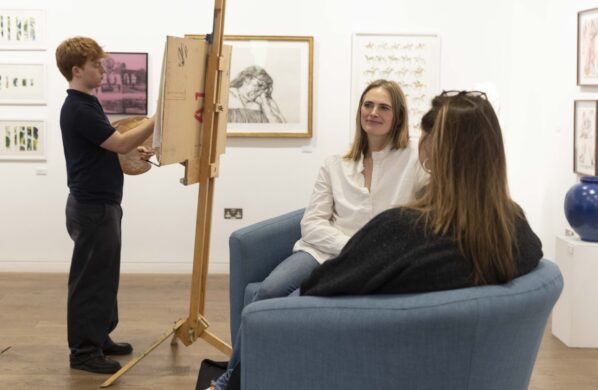
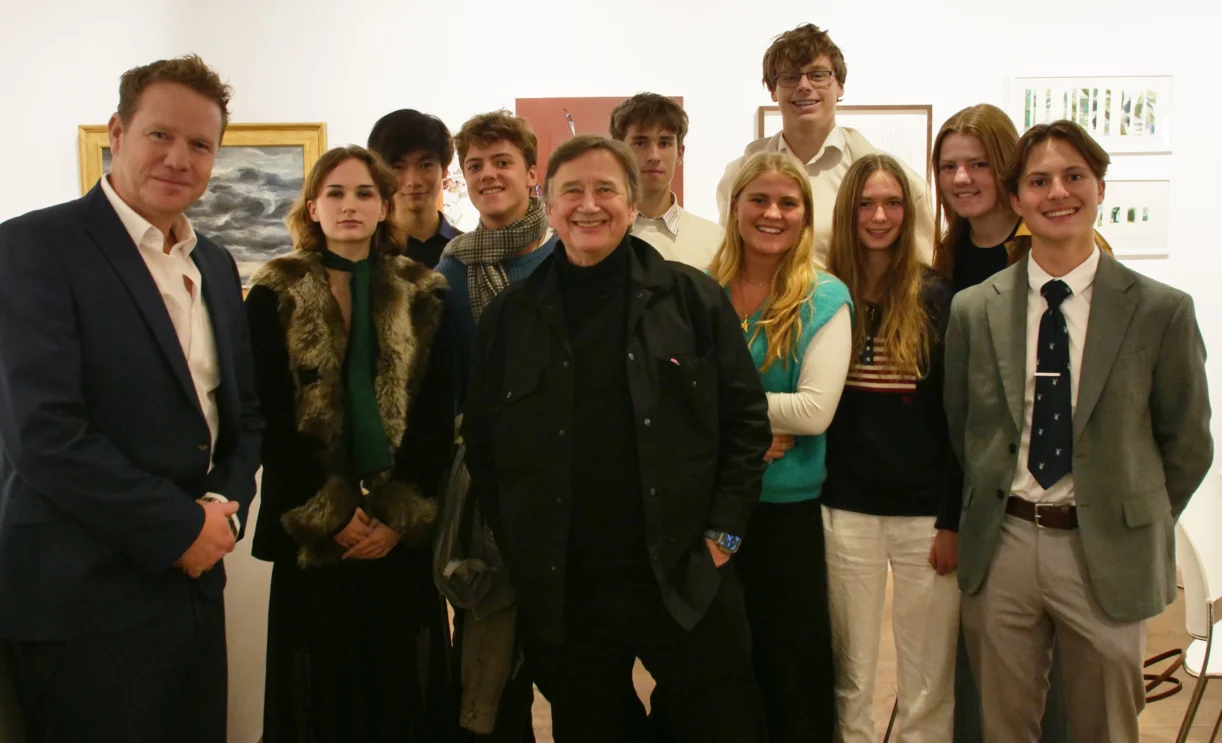
During the Re-Imagine Exhibition, Sebastian headlined a sold-out Spotlight event, hosted by OB Ambassador Peter Hardy.